Welcome to Lesson 1: your first step into mastering the science of keywords.
Most people assume rankings fail because of “SEO issues,” slow sites, plugins, or technical glitches. But in reality, over 70% of SEO failures begin with poor keyword decisions long before a single article is written.
Here’s the truth:
If you choose the wrong keyword, nothing else matters.
Not your content.
Not your backlinks.
Not your tools.
Not your website platform.
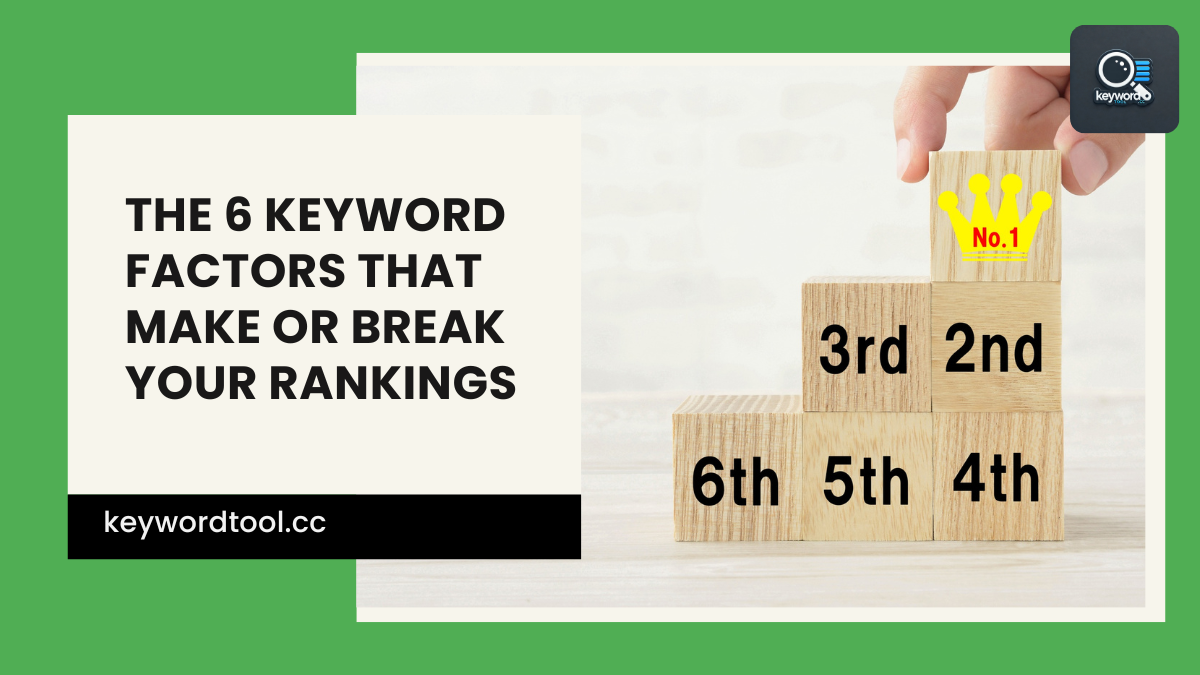
Behind every page that ranks on Google, you’ll find six keyword-driven factors that determine whether a site takes off, or disappears into page 3 oblivion.
1. Keyword Selection Quality
This is the foundation of everything.
A winning keyword must meet three criteria:
- People are searching for it
- It matches the way humans phrase the problem
- The competition level allows you to realistically rank
Most people fail on one of these three. You won’t.
Your goal:
Target keywords with real demand that you can actually win based on your site’s authority.
2. Search Intent Alignment
Google doesn’t rank content, it ranks solutions to intent.
Search intent categories:
- Informational
- Comparison
- Transactional
- Navigational
- Local
- Pain-point–specific
If your content answers a different intent than what users expect, you will never rank.
Example:
Targeting “SEO tools” with an article about “SEO tips” guarantees failure. Same topic, wrong intent.
3. SERP Reality Check
Forget theoretical SEO. The only truth is what ranks on page 1 right now.
For every keyword you target, you must analyze:
- The current top 10
- The format of content that ranks
- The type of entities ranking (blogs? brands? ecommerce?)
- The depth required to compete
- Whether Google prefers lists, guides, product pages, or videos
This determines your ranking difficulty, not the generic “KD Score” in tools.
The SERP is the real battlefield.
4. Topic Clustering & Keyword Ecosystems
One keyword rarely ranks alone.
Google rewards:
- Topical depth
- Content ecosystems
- Supporting pages
- Interlinked resources
- Clusters built around one central topic
Single articles don’t rank anymore. Topic systems do.
If you want to rank for a “big keyword,” you must earn your way there by creating supporting keyword content around it.
5. Competitive Gap Analysis
Keyword research is incomplete unless you also study:
- What competitors rank for
- What they ignore
- Which keywords bring them traffic
- Which opportunities they missed
- Where they are weak
Your job is to find keywords they overlooked and keywords they rank poorly for.
That’s where ranking becomes easy.
6. Human-Centered Content Signals
Even with the perfect keyword strategy, you must win the human side:
- Users need to stay on your page
- They must interact with your content
- They must read more
- They must not bounce
- They must feel like you understand their query
Google watches all of these user behaviors and adjusts rankings accordingly.
This is why keyword strategy must include how humans behave, not just how search engines crawl.
Your Takeaway From Lesson 1
Ranking is not luck. It’s math, psychology, and search intent.
Everything begins with the keywords you choose and how well those keywords align with human behavior and real SERPs.
In the next lesson, we’ll go deeper into the human-centered side of keyword selection.